Warning signs
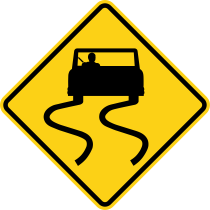
Slippery when wet
Standard MUTCD design · not an official government site
What it means
This sign marks a stretch where the surface loses grip unusually quickly in rain, snow or ice, because of polished pavement, a shaded microclimate, standing water or a curve that punishes low traction. The wavy skid lines above the car symbol describe exactly what happens there: vehicles that brake or steer normally find the surface has less to give than expected. The sign is conditional by design, and the trap is that the road looks perfectly ordinary on the dry day you first meet it.
How it gets misread
The commonest misread is ignoring the sign in light rain because grip feels normal, when polished surfaces lose their coefficient of friction before visible water accumulates. Another is assuming it applies only to the exact spot where the sign stands rather than the stretch it marks.
What to do
In any wet or icy condition, reduce speed below what you would choose on a normal road, lengthen your following distance, and make every input gentle: no abrupt braking, no sharp steering, no sudden throttle. If the rear begins to slide, ease off the accelerator and steer where you want to go without stomping the brake.
Practise this rule
- Rear Skid on a Wet Curve | CO
The rear of your vehicle slides out to the right while you are braking through a wet curve. What is the correct correction?
More warning signs
Sources
- Section referenced: Colorado Driver Handbook — Special Driving Conditions: Slippery Roads
- Colorado Driver Handbook, January 2025 (DR 2337) — English PDF · Spanish PDF
- Retrieved 2026-10-17 from Colorado Division of Motor Vehicles
The drawing above is an original illustration created for this site, based on the sign's published shape and colour conventions. It is not an official government reproduction.