Regulatory signs
Four-way stop
Standard MUTCD design · not an official government site
What it means
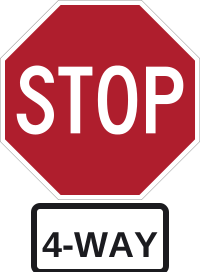
The 4-WAY plaque beneath a stop sign tells you that traffic on every approach to the intersection faces the same stop sign. That changes the behaviour the sign produces: instead of one road yielding to another, every driver stops and then follows a simple order of precedence. The first vehicle to stop completely is the first to go, and when two vehicles stop at the same moment, the driver on the left yields to the driver on the right. The plaque exists so that nobody treats their own approach as the priority road.
How it gets misread
Drivers sometimes read the plaque as meaning the intersection is all-way yield, or they assume the larger, faster or straighter-moving vehicle has priority after stopping. None of that is in the rule. Stopping order and right-of-position decide it, and eye contact or a hand wave does not replace either.
What to do
Make your full stop, then watch what the other approaches do. If you stopped first, go when it is clear, but only after confirming the driver to your right is not also moving. If you stopped together, yield to the vehicle on your right. When in doubt about who stopped first, hold back a beat and let the other driver commit; a lost second costs nothing, a guessing game at an intersection costs a great deal.
More regulatory signs
Sources
- Section referenced: Colorado Driver Handbook — Right of Way: Four-Way Stops
- Colorado Driver Handbook, January 2025 (DR 2337) — English PDF · Spanish PDF
- Retrieved 2026-10-17 from Colorado Division of Motor Vehicles
The drawing above is an original illustration created for this site, based on the sign's published shape and colour conventions. It is not an official government reproduction.