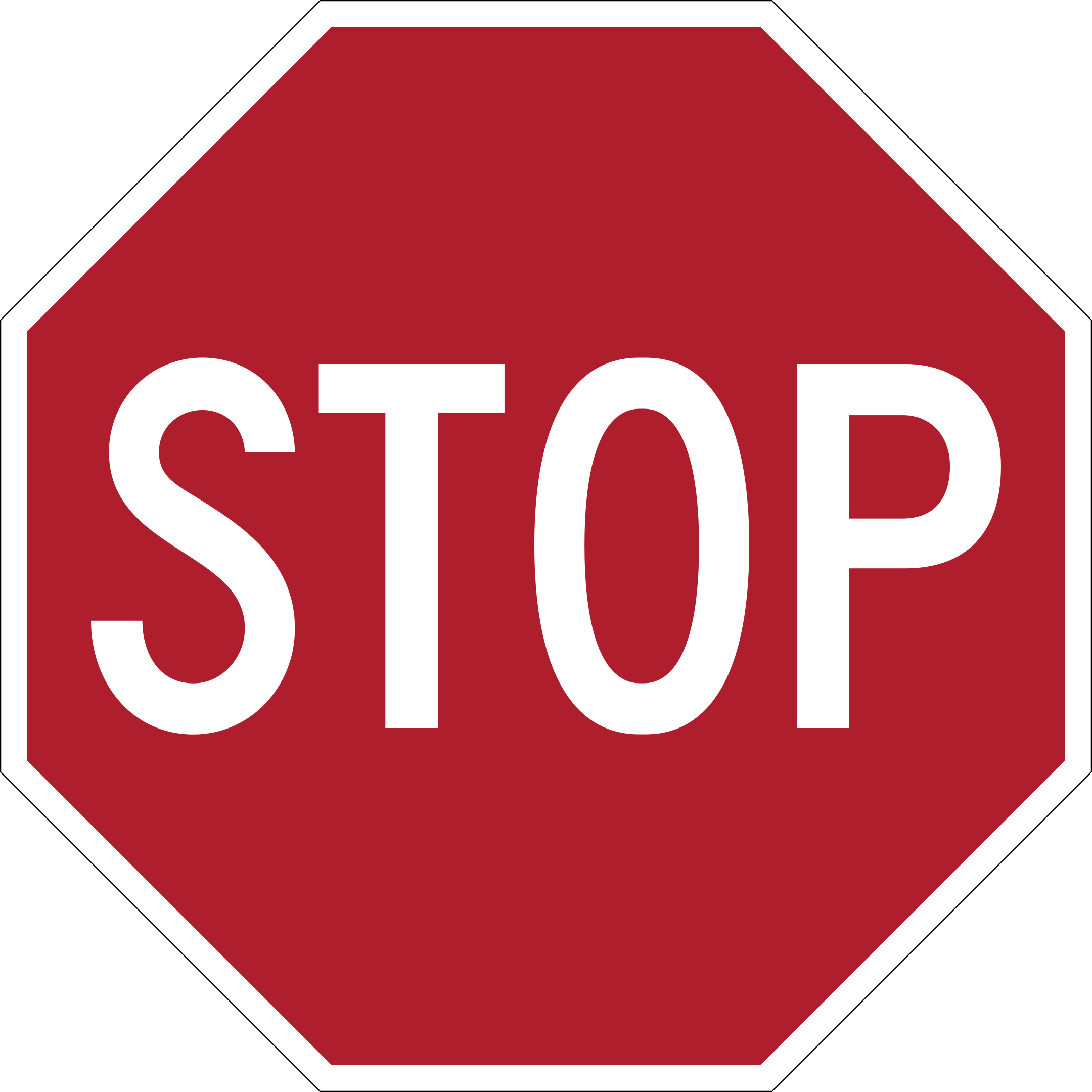
Regulatory signs
Stop
Standard MUTCD design · not an official government site
What it means
The stop sign is the strongest instruction a roadside sign can give: every approaching driver must come to a complete stop. Complete means the wheels stop turning, not a slow roll past the edge of the sign. Colorado places stop signs where two roads meet and visibility, traffic volume or crash history makes an uncontrolled crossing unsafe. The rule applies regardless of whether you can see other traffic, because the sign protects against the vehicle or pedestrian you cannot yet see coming around the corner.
How it gets misread
A common misread is that a stop sign only applies when another car is present, so an empty intersection can be treated like a yield. That is wrong. It also does not mean stop anywhere near the intersection; the stop must happen at a specific place, defined by pavement markings or the sign itself.
What to do
Stop fully at the marked stop line. If there is no line, stop before entering the crosswalk; if there is no crosswalk either, stop at the point where you can see, before entering the intersection. Look left, right and then left again, yield to pedestrians and cross traffic, and only move when you can enter without forcing anyone to slow. If your view is blocked, creep forward and stop a second time where visibility begins.
Practise this rule
- Stop Sign Rules: What an Octagon Means | CO
A red octagonal sign with white letters is posted ahead of you. What does it require?
- Where to Stop With No Stop Line | CO
You are stopping at a stop sign but no stop line has been painted on the pavement. Where must your vehicle come to rest?
More regulatory signs
Sources
- Section referenced: Colorado Driver Handbook — Signs, Signals and Pavement Markings: Regulatory Signs
- Colorado Driver Handbook, January 2025 (DR 2337) — English PDF · Spanish PDF
- Retrieved 2026-10-17 from Colorado Division of Motor Vehicles
The drawing above is an original illustration created for this site, based on the sign's published shape and colour conventions. It is not an official government reproduction.