Warning signs
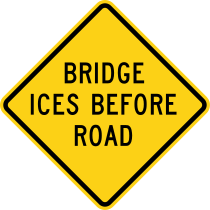
Bridge ices before road
Standard MUTCD design · not an official government site
What it means
This sign exists because of physics: a bridge deck is exposed to cold air on both surfaces, so it loses heat faster than the road, which is warmed from below by the ground. The result is a strip of pavement that freezes first, thaws last, and can be glazed with invisible black ice while the approaches on either side are merely wet. Canyon crossings, overpasses and high bridges in Colorado produce this effect on clear, cold nights even when the day was mild, and the sign marks the specific structures where it bites.
How it gets misread
The commonest and costliest misread is judging the surface by the road before and after the bridge, concluding that grip must be the same across the whole stretch. Another is believing ice requires visible frost or snow, when black ice on a deck is often invisible at driving speed.
What to do
From late autumn to spring, lift off the accelerator before the bridge rather than on it, hold your line absolutely steady, and avoid any brake or steering input while crossing if the deck might be glazed. If you do hit ice, do not brake; let the vehicle cross the strip and regain grip on the far side. Expect the same structure to be icy on your return trip.
Practise this rule
- Why Wet and Icy Roads Need Lower Speeds | CO
Why must you drive well below the posted limit when the road surface is wet or icy?
More warning signs
Sources
- Section referenced: Colorado Driver Handbook — Winter Driving
- Colorado Driver Handbook, January 2025 (DR 2337) — English PDF · Spanish PDF
- Retrieved 2026-10-17 from Colorado Division of Motor Vehicles
The drawing above is an original illustration created for this site, based on the sign's published shape and colour conventions. It is not an official government reproduction.